
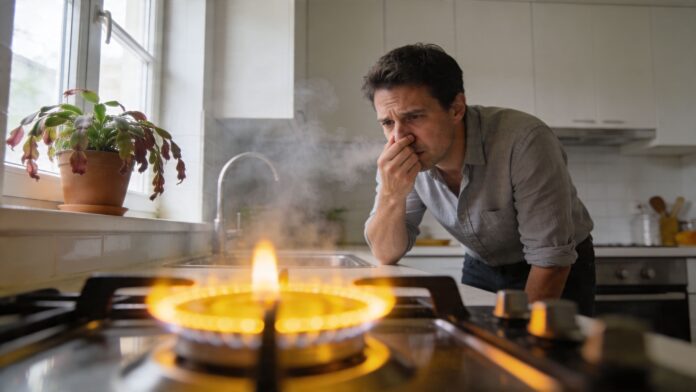
A faint sulfur smell at dinner time is easy to second-guess. Maybe it’s the trash. Maybe something spilled under the stove. Maybe it’s nothing.
That kind of hesitation is what makes gas problems dangerous. The early symptoms of gas leak in house situations often don’t look dramatic. They show up as a smell you can’t place, a headache that seems random, a pilot flame that doesn’t look right, or a family member who says they feel better the minute they step outside.
In homes across eastern Dallas, natural gas is part of daily life. It heats water, fuels cooktops, and keeps furnaces running when temperatures drop. But according to ACS Publications, 17 people die annually in the United States from natural gas leaks and the deadly explosions they trigger, as noted by Benjamin Franklin Plumbing’s summary of that ACS finding. That’s why a suspected leak has to be treated as a safety issue, not a maintenance chore.
Your Guide to Gas Leak Safety in Eastern Dallas
In this part of Texas, a lot of homeowners know the rotten egg smell. Fewer know what to do next. Even fewer know how to tell the difference between a natural gas leak and carbon monoxide trouble, and that confusion can lead people to take the wrong first step.
That matters in neighborhoods from Lone Oak to Rockwall to Wylie, and just as much for anyone in Dallas plumbing service areas. A gas leak can start at an appliance connection, a line in the wall, or piping outside the home. Sometimes it announces itself clearly. Sometimes it doesn’t.
Practical rule: If something feels off and gas is even a possibility, act first and sort it out second.
Most homeowners don’t need more jargon. They need a clear way to think through what they’re seeing, smelling, and feeling. That starts with the basics. Use your senses first. Then pay attention to how your body reacts in the house. Then separate two hazards people mix up all the time: natural gas leaks and carbon monoxide poisoning.
A lot of online advice blends those together. That’s a problem. One hazard usually comes with a sulfur-like warning smell. The other doesn’t. One often points you toward the gas utility. The other can mean a 911 emergency with no odor at all. Knowing which is which helps you make the right call faster.
Using Your Senses to Detect a Gas Leak
Your first warning usually isn’t a physical symptom. It’s something you notice in the home itself. Think in three buckets: smell, sound, and sight.
Smell what the odor is telling you
Natural gas doesn’t have a smell on its own. Utility companies add mercaptan, a sulfur-based odorant, so people can detect leaks. It can be noticed at concentrations as low as 1 part per billion, according to Seitron’s explanation of mercaptan and leak detection limits.
That rotten egg or sulfur smell is the classic warning sign. If you catch it near a range, water heater, furnace, meter, or along an interior wall, take it seriously. A stronger smell can mean more gas is present, but don’t assume a faint smell means a minor problem.
There’s another piece homeowners miss. No smell doesn’t always mean no leak. Mercaptan can fade when soil absorbs it around an underground leak, and people can also become used to the odor after repeated exposure. If you want a homeowner-friendly overview of how to detect gas leaks, that guide does a good job walking through the practical warning signs.
If your house smells “off” and you can’t decide whether it’s sewer gas or natural gas, don’t guess from smell alone. There’s a difference between a drain odor problem and a fuel gas problem, and this guide to septic smell in the house can help you understand why the source matters.
Listen for pressure escaping
Gas under pressure often makes itself known before anyone sees visible damage. The sound can be a hiss, a soft whistle, or a more noticeable rushing noise near a pipe, shutoff, appliance connector, or meter area.
This is one of the more reliable real-world clues because it usually points to active escape. If the sound is coming from a fixed pipe or connection, that’s not something to inspect up close. Back away and treat it as an emergency.
A useful field habit is to stop moving around the house for a moment and listen. Homeowners often keep searching visually and miss the sound entirely. In a quiet room, a leak can be easier to hear than to smell.
Look for visible signs inside and outside
A gas leak can also leave clues you can see.
Inside the house, watch for:
- Pilot flame changes: A healthy pilot flame is typically blue. If it’s burning orange or yellow, that can point to a combustion problem.
- Appliances that won’t stay lit: Repeated pilot outages or burners acting oddly deserve attention.
- Dust movement near a line: In some situations, escaping gas can disturb light debris around a connection point.
Outside the house, watch for:
- Dead or browning vegetation: If one patch in the yard suddenly looks worse than everything around it, that can be a clue around buried gas lines.
- Bubbling in wet soil or standing water: Escaping gas can show up in soggy areas before the source is visible.
- Ground disturbance that doesn’t make sense: Unusual surface changes near buried piping are worth treating carefully.
The trade-off here is simple. Sensory clues are fast, but they’re not perfect. Smell can fade. Sound can be missed if the home is noisy. Visual signs can be subtle. That’s why the best approach is to trust the warning signs you do have and avoid talking yourself out of them.
Recognizing the Physical Symptoms of Gas Exposure
A lot of homeowners assume natural gas harms you because it’s poisonous. That’s not the usual mechanism. Natural gas is non-toxic but causes injury by displacing oxygen, which creates a hypoxia problem. Tennessee Standard’s summary of gas leak symptoms describes that progression from early symptoms like headaches and dizziness to severe outcomes like loss of consciousness.

That’s why the symptoms of gas leak in house cases can feel vague at first. People often describe it as feeling “off” indoors and better outside, especially with slow leaks that don’t create a dramatic smell.
What mild exposure can feel like
Early symptoms often include:
- Headache
- Dizziness
- Nausea
- Fatigue or unusual sleepiness
Those are easy to misread as stress, dehydration, a virus, or poor sleep. In practice, that’s one reason leaks go unrecognized. The symptoms don’t announce themselves as “gas exposure.”
What a worsening situation looks like
As oxygen displacement becomes more serious, symptoms can become harder to ignore:
- Confusion
- Difficulty breathing
- Poor coordination or loss of muscle control
- Lightheadedness that feels stronger indoors
- Loss of consciousness in severe cases
One practical clue matters more than people realize. If symptoms start when you’re at home, worsen in one area of the house, and improve after you leave, that pattern points to an environmental issue rather than a random illness.
A symptom pattern tied to the house is never something to “wait and see” overnight.
What doesn’t work is trying to diagnose the exact source by how you feel alone. Symptoms are a lagging warning sign. By the time someone feels sick, the house may already have a serious air problem. If there’s any suspicion of a leak, the right move is evacuation and professional evaluation, not opening a window and going back to the couch.
If a leak is confirmed and repairs are needed, that’s the point for a licensed team that handles gas leak repairs. But repair comes after the property has been made safe, not before.
Gas Leaks vs Carbon Monoxide What Dallas Homeowners Must Know
Many homeowners get tripped up. They smell something strange, feel dizzy, and search online. Then they get advice that mixes natural gas and carbon monoxide together as if they’re the same problem. They aren’t.
According to Go Preferred Services’ explanation of gas leak versus CO warning signs, a natural gas leak is associated with the mercaptan odorant, often described as rotten eggs, while carbon monoxide is odorless. Their emergency responses overlap in one way, which is evacuation, but they diverge after that.
A side by side comparison
| Characteristic | Natural Gas Leak | Carbon Monoxide (CO) |
|---|---|---|
| Source | Escaping fuel gas from a pipe, connector, valve, appliance, or line | Incomplete combustion from fuel-burning equipment |
| Smell | Often rotten egg or sulfur smell from added odorant | Odorless |
| Common clue | Smell, hissing, visible signs near gas line or appliance | CO alarm sounding, flu-like symptoms without odor |
| Primary danger | Fire, explosion, and oxygen displacement | Poisoning from combustion gas |
| Detection method | Human senses may help, but professional testing confirms | CO alarm is critical because you can’t smell it |
| Immediate action | Evacuate and call the gas utility | Evacuate and call 911 |
The simplest diagnostic framework
If you want the shortest version, use this:
- Rotten egg smell present: Think natural gas leak first.
- No smell, but people feel sick and a CO alarm is sounding: Think carbon monoxide.
- Visible combustion issue, such as a flame that doesn’t look right: Don’t self-diagnose. Leave and have the system evaluated.
- Unsure which one it is: Treat it like an emergency and get everyone out.
The confusion usually happens because both situations can involve headache, dizziness, nausea, and fatigue. That overlap is real. The difference is that a natural gas leak often gives you a smell clue, while carbon monoxide does not.
Why the response has to match the hazard
With a natural gas leak, the major concerns include ignition and oxygen displacement. With carbon monoxide, the concern is poisoning from a combustion byproduct that your nose won’t catch. That’s why homes need the right alarms and why people shouldn’t rely on symptoms alone.
If you’re also thinking more broadly about home air quality, it’s worth understanding other hidden indoor air pollution sources that can muddy the picture. Homeowners often lump every breathing-related issue into one category, and that leads to slow decisions when speed matters.
Rotten egg smell usually points you toward a gas leak response. No smell with a CO alarm points you toward a carbon monoxide emergency response.
That distinction sounds basic. In an actual emergency, it can keep someone from making the wrong call and losing time.
Your Immediate Safety Action Plan for a Suspected Gas Leak
The first few minutes matter most. If you suspect a leak, keep your actions simple and safe.

What to do right away
-
Stop using switches and electronics.
Don’t flip lights on or off. Don’t plug anything in. Don’t use a garage door opener. Even a small spark is too much risk around leaking gas. -
Put out open flames if you can do it instantly and safely.
A candle, gas burner, or fireplace adds danger. If extinguishing it would put you in the leak area longer, leave it and get out. -
Get everyone outside.
Move people and pets out immediately. Don’t stop to gather bags, paperwork, or chargers. -
Leave the building and create distance.
Go far enough away that you’re not standing near the structure, meter, or yard line. -
Call for help from a safe location.
Once you’re outside and away from the property, contact the gas utility for a suspected leak. If the situation is severe, or if there’s any sign of illness, fire risk, or uncertainty, call 911.
What not to do
Some mistakes show up again and again in real service calls:
- Don’t try to “find it” with your face near the appliance.
- Don’t re-enter for keys, phones, or pets if they’re already not in reach.
- Don’t assume opening a window makes the house safe again.
- Don’t relight pilot lights after a suspected leak.
This short video is worth watching because the basics need to be automatic under stress.
When a plumber comes into the picture
The gas utility or emergency responders handle the immediate hazard side first. They determine whether the property is safe enough for the next step. After shutdown, isolation, or emergency clearance, a licensed plumber can locate the failed section, test the line, and make the repair.
If you need fast help after the property has been secured, that’s when an emergency plumbing service becomes the right call. The order matters. Safety first. Repair second.
Preventing Gas Leaks with Professional Maintenance
Emergency response matters. Prevention is better.
Most residential gas leaks don’t start with drama. They start with wear. A connector ages. A fitting loosens. An appliance gets replaced and the gas connection isn’t evaluated as carefully as it should be. In older homes, pipe condition and past workmanship can both become factors.
Where preventive checks make the biggest difference
The smartest time to inspect a gas system is before anyone smells anything. That’s especially true in a few situations:
- Older homes: Aging piping, appliance valves, and legacy connections deserve closer attention.
- After remodeling: Renovation work can affect appliances, shutoffs, wall penetrations, and line routing.
- After buying a house: A standard move-in checklist often misses gas-specific concerns.
- When appliances are changed: A new cooktop, range, dryer, or water heater can expose old connection issues.
What works is a professional inspection with actual testing methods. What doesn’t work is assuming a quick sniff test around the stove counts as prevention.
What professionals actually check
A proper maintenance visit should focus on the full gas system, not just the appliance you’re worried about. That can include:
- Pressure testing: Used to verify whether the line is holding properly.
- Leak detection equipment: Useful when odor alone isn’t dependable.
- Connection inspection: Flexible connectors, shutoff valves, and fittings need visual and functional review.
- Appliance evaluation: Burners, ignition, venting behavior, and flame quality can point to system issues.
- Targeted repair planning: If there’s a problem, the goal is to isolate the exact section and fix it cleanly.
This is one reason homeowners should insist on a licensed plumber for fuel gas work. If you’re weighing that decision, this guide on when to hire a licensed plumber for a gas line explains why licensing matters so much on gas systems.
The best gas leak repair is the one you never need because someone found the weakness before it turned into an emergency.
The real trade-off for homeowners
People sometimes delay inspections because nothing seems wrong. I understand the instinct. If the range lights and the water heater runs, it’s easy to move gas line maintenance to the bottom of the list.
The problem is that gas issues don’t always announce themselves early. Some leaks are obvious. Others are subtle until they aren’t. The practical trade-off is simple: spend time on inspection now, or spend much more time dealing with evacuation, utility shutoff, repair scheduling, and safety risk later.
For landlords and property managers, the same logic applies at a larger scale. Turnovers, appliance swaps, and tenant complaints about odd smells should trigger a serious check, not a guess.
Frequently Asked Questions About Gas Leak Safety
After a gas scare, Dallas homeowners usually ask the same few questions. The right answer matters because a natural gas leak and carbon monoxide exposure do not call for the same assumptions, even though both can make people feel sick.
How quickly can gas leak symptoms appear
Symptoms can show up fast during a larger leak, especially if gas is building up in a closed space. Lower-level exposure can be harder to spot because people may brush it off as fatigue, a headache, or feeling off at home, according to Healthline’s overview of gas leak symptom timing.
Here’s the practical point. If you smell rotten eggs, hear a hissing sound near a gas line, or notice symptoms that improve after you leave the house, treat it as a gas emergency first. If there is no gas odor at all, but people feel sick around fuel-burning equipment, that raises a different concern and carbon monoxide needs to be considered.
If I smelled gas and now it seems gone, can I go back inside
No.
I’ve seen homeowners step outside, catch a few breaths of fresh air, then decide the house must be fine because the smell faded. That is a bad call. Gas can collect in one area, shift through the structure, or stop being obvious to your nose after a few minutes.
Wait for the utility company or emergency responders to tell you the home is safe to enter. Until then, stay out.
Are some houses more likely to have gas leak issues
Yes. Older homes with aging gas piping, worn appliance connectors, past remodel work, or recent appliance swaps tend to have more risk points. Homes with several gas appliances also have more fittings, shutoff valves, and connection points that can fail over time.
That does not mean a newer house gets a pass. I’ve found problems in newer installations too, usually tied to poor workmanship, loose fittings, or equipment changes that were never checked as a full system.
Can I solve the problem by opening windows
Opening windows may lower the gas concentration, but it does not confirm the leak has stopped and it does not clear the house for normal use.
It also does nothing for carbon monoxide if the source is a venting problem that starts up again when the appliance runs. That confusion gets people into trouble. Fresh air can make symptoms feel better for a while, but symptom relief is not the same as a safe house.
How can I tell the difference between a natural gas leak and carbon monoxide
Start with what you can observe. Natural gas is usually noticed by smell first. People describe it as rotten eggs or sulfur because utility companies add that warning odor. Carbon monoxide has no smell, no color, and no taste.
Symptoms can overlap, which is why homeowners mix the two up. Headache, nausea, dizziness, and fatigue can happen with either one. The key difference is that a gas leak often comes with a clear environmental clue, like odor, a hiss, or dead plants near a line. Carbon monoxide usually does not announce itself that way. It is more often tied to running fuel-burning appliances, poor venting, or symptoms that affect multiple people indoors without any gas smell.
Treat both as serious. Leave the home if you suspect either one, then call for help. Use your gas utility or 911 for a suspected gas leak. Use 911 right away if anyone may have carbon monoxide exposure or is having severe symptoms.
What’s the best household habit to reduce risk
Take patterns seriously.
If a room smells sulfur-like, a burner flame looks wrong, an appliance starts acting up, or someone feels worse inside than outside, act on it the same day. Waiting for a second or third warning is how minor issues turn into emergency calls.
If you need a licensed local team to inspect a suspected leak, repair a damaged gas line, or evaluate plumbing issues affecting your home’s safety, contact On The Way Plumbing Leak Specialist. We serve Lone Oak, Hunt County, and the greater eastern Dallas area with experienced, safety-focused plumbing support when the situation can’t wait.