Clogged toilet help from Lone Oak, TX
When to Call a Plumber for a Clogged Toilet
Most clogs come out with a good plunger and a little patience. When the plunger isn't working, the toilet keeps clogging, or water shows up in the tub, it's time to call a plumber for a clogged toilet. Here's how to tell the difference, and what to do in the meantime.
Toilet about to overflow? Do this first
- Don't flush again. A second flush on a clogged toilet is how bathrooms flood.
- Close the shutoff valve. Plumbers call it the angle stop. It's the small oval handle on the wall or floor behind the toilet. Turn it clockwise until it stops.
- If the valve is stuck, take off the tank lid. Inside the toilet tank, push the flapper down to stop water going into the bowl, and lift the float so the tank stops filling.
- Lay down towels and wait. Give the bowl a few minutes to drain down before you plunge, so you're not splashing water over the rim.
If the shutoff valve spins and won't close or it leaks when you turn it, call (903) 458-4026. Old valves fail like that all the time, and we replace them.
How to clear a simple toilet clog yourself
A lot of clogs are just too much paper at once. Try these in order before you call anybody. If you've worked through all of them and the water still sits in the bowl, stop there and keep reading.
Use the right plunger
You want a flange plunger, the kind with a soft rubber sleeve that sticks out of the bottom of the cup. The flat sink plunger can't seal the drain opening in a toilet bowl, so most of your effort just pushes water around. Make sure there's enough water in the bowl to cover the rubber cup.
Get a seal and work it
Fit the flange into the opening, push down slowly the first time to get the air out, then work it in and out with firm, steady strokes. Pulling back matters as much as pushing. Give it 15 to 20 strokes before you pull up and check. Two or three honest rounds is plenty.
Try dish soap and hot water
If plunging moves things a little but not all the way, squirt a good amount of dish soap into the bowl and follow it with a bucket of hot tap water. Not boiling water, which can crack porcelain. Let it sit 20 to 30 minutes so the soap can slick up the clog, then plunge again.
Run a toilet auger if you have one
A toilet auger (also called a closet auger) has a rubber sleeve that protects the bowl and a short cable that reaches through the trapway. Crank it in, pull it back, and flush once to test. Skip the regular drain snake from the hardware store, because it scratches the porcelain and tends to coil up in the bowl.
Leave the chemical drain cleaner on the shelf
Chemical drain cleaner rarely gets through a toilet clog, it can damage porcelain and older pipes, and it makes the job unsafe for whoever comes out next. If you're on a septic system, it's also hard on the bacteria in the tank. Our post on how to prevent drain clogs covers what's safe to use around the house.
Signs you need a plumber for a clogged toilet
Some clogs are right there in the bowl. Others are farther down the line, and no amount of plunging reaches them. These are the signs that the problem is past what a homeowner can fix, and when it's worth calling a plumber for a clogged toilet. Our drain cleaning service handles the ones that go deeper than the toilet.
The plunger isn't working after a few honest tries
If the plunger isn't working after a few rounds with a flange plunger and an auger, the clog is either packed tight in the trapway or it's past the toilet entirely. More plunging at that point mostly wears you out and pushes the clog tighter.
Water is backing up into the tub or shower
When you flush and water comes up in the tub, or the shower drain gurgles, the clog is in the shared drain or the main sewer line, downstream of the toilet. That's a clog for a plumber with a cable machine and access at a cleanout. Stop running water in the house until it's cleared.
More than one drain is slow
One slow toilet is a toilet problem. A slow toilet plus a slow tub plus a sink that won't drain points to the main sewer line. If you're on septic, it can also mean the tank is full or the line to the tank is blocked.
Gurgling, bubbling or a sewer smell
Gurgling in the bowl when another fixture drains, or bubbles rising when the washer empties, usually means air is getting pushed or pulled through the drain. That comes from a partial clog in the line or a blocked vent pipe on the roof. A sewer smell along with it means don't wait on it.
Something solid went down
Toys, phones, toothbrushes, and pill bottle caps can wedge in the trapway where a plunger can't move them. Plunging can push the object farther in. Stop and call, because pulling the toilet usually gets it out cleanly.
It overflowed or it's leaking at the base
If the bowl overflowed, water may have gotten under the toilet and into the subfloor. A toilet that rocks or leaks at the base after a clog may have a broken wax ring seal, and that needs fixing before it rots the floor.
Why your toilet keeps clogging
If your toilet keeps clogging every week or two, something is setting it up to fail. Plunging fixes the clog in front of you and leaves the cause sitting there. These are the usual reasons we find.
Flushable wipes and too much paper
Flushable wipes don't break down in water the way toilet paper does. They hang up in the trapway and the drain line, catch paper behind them, and build into a clog over a few days. Thick, quilted paper used by the handful does the same thing. If you have kids, a quick talk about how much paper goes in at once fixes a lot of repeat clogs.
An older low-flow toilet
The first wave of low-flow toilets from the 1990s used less water per flush without a good bowl design to make up for it. If your house has one of those originals, it may never flush well no matter what you do. Newer models flush a lot better on the same amount of water, and sometimes replacing the toilet is the actual fix.
Mineral buildup in the rim holes and jet
Hard water leaves scale in the little rim holes under the lip of the bowl and in the siphon jet at the bottom. As those close up, the flush gets weaker and stops clearing the bowl. If you see crusty white or brown deposits around faucets and showerheads too, a water softener is worth looking at.
Trouble in the drain line
Tree roots in the sewer line, a sagging section (a belly) where waste settles, or an old cast iron line rough with scale can all catch paper and make the toilet the first thing to back up. Expansive clay soil around Hunt County swells when it's wet and shrinks in a drought, and that movement can shift buried pipe out of line over time.
A full septic tank
On a septic system, a full tank or a blocked line out to the tank slows every drain in the house, and the toilet usually shows it first. If that sounds like your place, read our septic system maintenance tips, and have a licensed septic company pump the tank if it's due.
What a plumber does that a plunger can't
When we come out for a clogged toilet, we start by asking what happened: when it started, whether other drains are slow, and whether anything went down that shouldn't have. That tells us where to look before we touch anything.
For a clog in the toilet itself, we run a closet auger through the trapway. If something solid is stuck, or the clog won't budge, we pull the toilet, clear it from the bottom, and reset it on a new wax ring. That's also how we get out the toys and phones a plunger can't reach.
If the clog is past the toilet, we go in through a cleanout with a cable machine sized for the main sewer line. For clogs that keep coming back, a camera inspection shows what's going on inside the line: roots, a belly, a broken joint, or grease and scale. When the line is coated with buildup or roots, hydro jetting scours the pipe walls clean instead of just poking a hole through the clog.
Before we start any of that, we explain what we found, give you your options, and give you an upfront quote. Customers mention that in their reviews a lot, and it's how we like to work. We have plumbers on call 24/7 for the clogs that can't wait until Monday. If the toilet itself is cracked, worn out or just never flushed right, our toilet repair and installation page covers replacement.
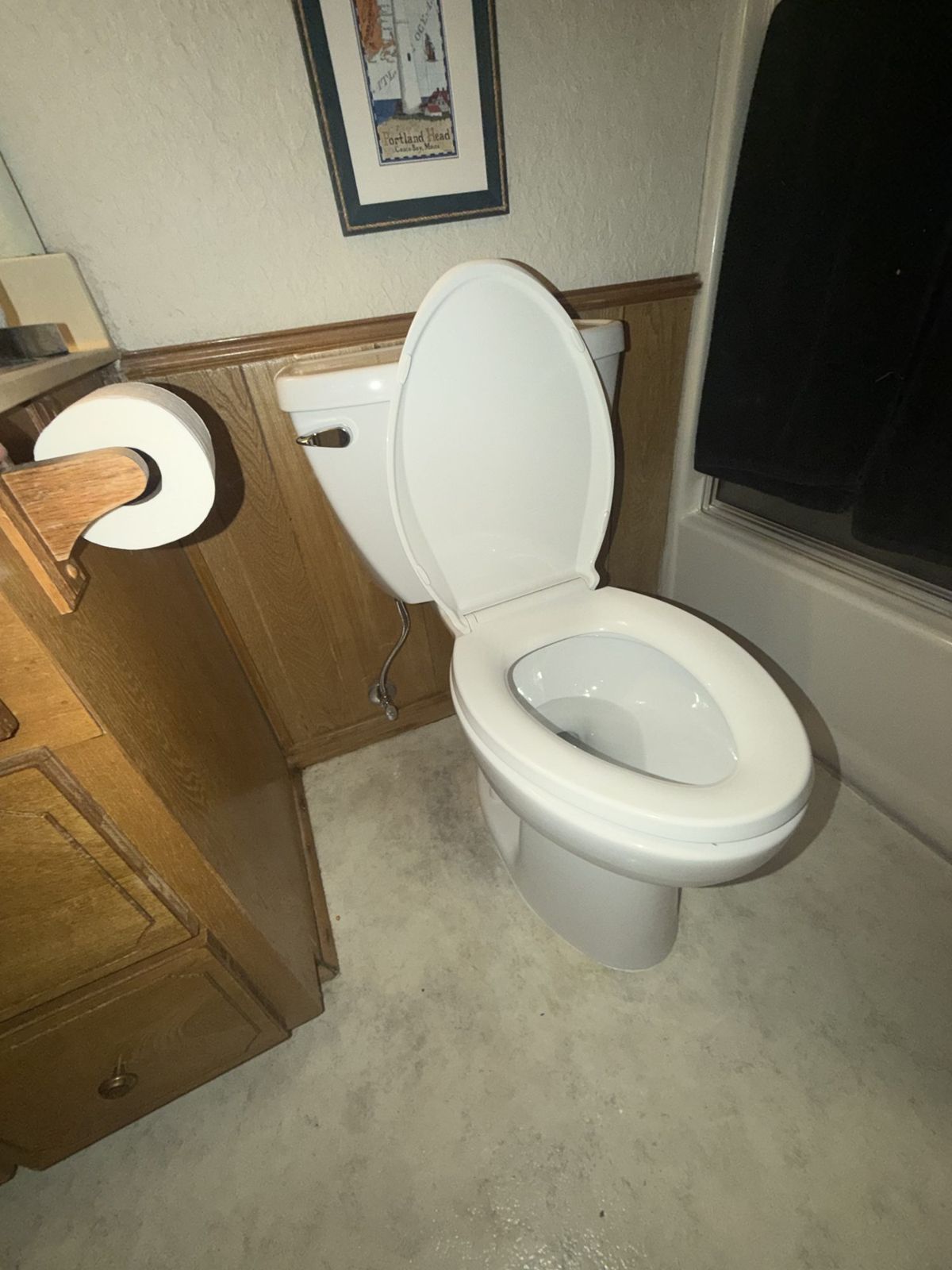
A new toilet we installed, set on a fresh wax ring.
Other toilet problems worth a call
Clogs get the most calls, but a few other toilet problems are worth having a plumber look at, mostly because they cost you money or damage the floor while you wait.
A running toilet
A running toilet that hisses or refills on its own is leaking water from the tank into the bowl, usually past a worn flapper or through a fill valve that won't shut off. It can run for days without anyone noticing and show up as a jump on your water bill. Put a few drops of food coloring in the tank, wait 15 minutes without flushing, and if color shows up in the bowl, the flapper is leaking. On a septic system, that steady trickle also adds water the tank doesn't need.
A weak flush
If you have to flush twice, check that the tank fills to the line marked inside it and that the chain on the flapper isn't too loose. If those look right, the problem is usually a partial clog or mineral buildup in the jet. We can tell you which one it is and whether cleaning or replacing the toilet makes more sense.
Water around the base
Water on the floor around the base comes from a failed wax ring, loose closet bolts, a leaking supply line, or a crack in the bowl or tank. Wipe it dry and watch where it comes back. Don't just keep cranking the bolts down, because that's an easy way to crack the porcelain. If you can't find the source, our leak detection crew can.
What our customers say about toilet calls
★★★★★
"Blake and JB came out and fixed toilet clog on a Sunday and were done in 20 minutes"
Ryan G. · Google review
★★★★★
"I reached out to the company after a DIY disaster with my toilet, and I'm so grateful for how quickly and kindly they responded."
Trivia G. · Google review
★★★★★
"We had a bad backup into our house. They were professional and helpful"
Barbara E. · Google review
★★★★★
"He pinpointed my issue in minutes, and took care of it. He also gave me great tips to help prevent stoppage in the future."
Daryn C. · Google review
Common questions
Toilet still won't go down?
Call or text (903) 458-4026 and tell us what you've tried. We'll get a plumber out with the right tools and tell you the cost before we start.