
HomePlumbing ServicesGas Line Installation and Repair
Gas line repair in Lone Oak, TX and Hunt County
Gas Line Repair and Installation
Gas line repair is one job you don't want done halfway. On The Way Plumbing finds and fixes gas leaks, replaces bad gas lines and runs new lines for stoves, dryers and water heaters around Lone Oak, Hunt County and Rains County. Every job gets a pressure test before we call it done.
- 5.0 on Google from 354 reviews
- Texas license M-44817
- Family owned in Lone Oak, TX
- Free estimates, upfront pricing
- Emergency plumbers on call 24/7
Smell gas? Do this first
- Leave the house now. Get everyone out, pets too. Leave the door open on your way out if it's right there.
- Don't make a spark. Don't flip light switches, unplug anything, start a car in an attached garage, light anything or use your phone inside.
- Call 911 or your gas company from outside, well away from the house. If you're on propane, call 911 or your propane supplier.
- Stay out until they say it's safe. Don't go back in to look for the leak yourself.
- Then call us for the repair at (903) 458-4026. We have plumbers on call 24/7 for emergency plumbing.
Signs you need gas line repair
Natural gas has no smell on its own. The gas company adds an odorant called mercaptan so you'll notice a leak. Smell is the big one, but it's not the only sign. Our post on symptoms of a gas leak in the house goes deeper on each of these.
Rotten egg smell
A rotten egg smell near an appliance, the meter or anywhere in the house means gas is getting out somewhere. A faint whiff right when a burner lights can be normal. A smell that hangs around is not.
Hissing sound
A hissing sound near a gas line, valve or appliance connection means gas escaping under pressure. Treat it like the smell: get out and call from outside.
Dead grass or bubbles outside
A buried gas line that leaks can kill the grass in a strip or patch above it. If you see bubbles coming up through a puddle or muddy spot over where the line runs, that's another sign.
A gas bill that jumps
If your gas bill climbs and your use hasn't changed, a slow leak is one possible reason. It's worth a pressure test to rule it out.
Yellow or lazy burner flames
Gas burners should burn mostly blue. A yellow flame or one that lifts and flickers usually means a burner or air problem at the appliance. It's not always a leak, but it's worth checking because poor burning can also make carbon monoxide.
Headaches or dizziness indoors
Headaches, dizziness or nausea that ease up when you leave the house can point to a gas leak or carbon monoxide. Get out, get fresh air and call 911.
How we find gas leaks: pressure testing and pinpointing
The first question is simple: is the gas system holding pressure or not? We answer it with a pressure test. We shut off the gas, connect a pressure gauge to the system, bring it up to test pressure and watch it. If the needle holds steady, the piping is tight. If it drops, there's a leak somewhere, even if nobody can smell it yet.
Then we narrow it down. We isolate sections of the system by closing appliance shutoff valves and testing branch by branch. At suspect spots (fittings, unions, valves, appliance connectors) we use a leak detection soap solution that bubbles where gas escapes. Plumbers also use electronic gas detectors to sniff out leaks along a run. The goal is to find the exact fitting or section that's leaking before we start replacing anything.
This is where experience shows. Caressa M. said our guys noticed one of her gas leaks almost instantly and hunted down a second one because they saw the pressure gauge move just a little. Share M. had Chad and JB find two gas leaks in a matter of minutes after another plumber didn't catch it at all. For more on what happens after the leak is found, read our post on gas leak repairs.
Gas leak repair and gas line replacement
Once the leak is pinpointed, the fix depends on what failed and what shape the rest of the line is in. We'll explain what we found, show you, and give you the options with an upfront quote before we start.
Fittings, valves and flex connectors
A lot of gas leak repair work is at the connections: a fitting that's worked loose, an old shutoff valve, or a worn flex connector behind the stove, dryer or water heater. Those are usually quick repairs. Old flex connectors are worth replacing any time an appliance gets moved or swapped, since they don't take bending well as they age.
Corroded or damaged pipe
Gas pipe can rust where it runs through damp crawl spaces, sits against soil or passes through a wall without protection. A buried yard line can get hit by a shovel, a post hole digger or a trencher. Corroded pipe or a damaged section gets cut out and replaced, not patched.
When it's time to replace the line
If the pipe has several leaks, heavy rust along its length, or keeps failing in new spots, it's time to replace the line. Rosalind F. needed her gas line replaced because of a leak, and Chad and JB took care of it.
Red tags and getting service back on
If the gas company found a leak, they may shut off your meter and put a red tag on it. Service usually won't be turned back on until the leak is repaired and the system can pass a pressure test. We do the repair and the test, and let you know what the gas company needs to restore service.
Gas line installation for new appliances
Gas line installation is about more than getting gas from point A to point B. The line has to be the right size for everything it feeds, with a shutoff valve at each appliance, run and supported to code, and tested before anything gets lit. The post on natural gas line installation questions answers a lot of the common ones.
Gas line for a stove or range
Switching from electric to a gas range is one of the most common requests we get. We run a gas line for a stove from the nearest line that has enough capacity, put a shutoff valve behind the range and connect it with a new flex connector. Most gas ranges also need a regular outlet for the igniter and clock, so check that you have one behind it.
Gas line for a dryer
A gas line for a dryer is usually a short run in the laundry room, but the dryer also needs a proper vent to the outside. We'll check the vent while we're there.
Water heaters and tankless upgrades
Going from a tank to a tankless water heater often means a bigger gas line, since a whole house tankless can use a lot more gas at full fire. If the line is too small, the heater starves and throws errors. See our tankless water heater installation page for the rest of that job.
Outdoor grills, fire pits and generators
An outdoor grill or fire pit on a gas line means no more running out of propane mid cookout. Standby generators need a line sized for their full load. Outdoor runs are often buried, so depth, pipe type and where the line comes out of the ground all matter.
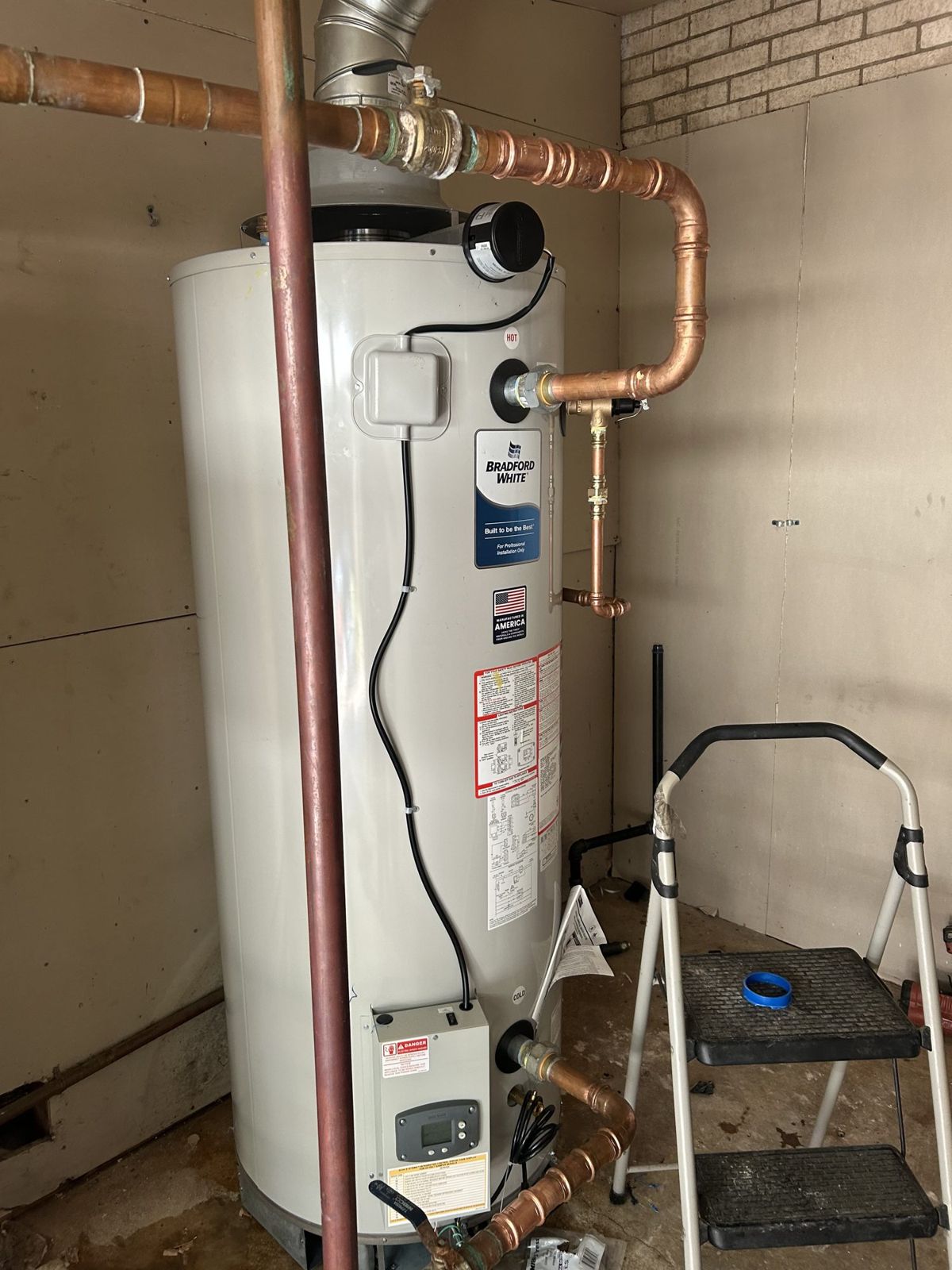
New gas and water connections on a water heater we installed.
How a gas line job goes
Whether it's a leak or a new line, the process is about the same.
Call or text
Call or text (903) 458-4026. If you smell gas right now, follow the safety steps above first. For a new line, tell us the appliance, where it's going, and send a photo of the spot and your meter if you can.
Test and find
For a leak, we pressure test and pinpoint it. For a new line, we check where we can tie in and whether the existing line has enough capacity for the added load.
Upfront quote and options
We explain what we found and what it costs before we start. Estimates are free, and financing is available on larger jobs.
Repair or install
We make the repair or run the new line, with shutoff valves where they belong.
Pressure test and relight
We pressure test the system again to make sure it holds, then turn the gas on, purge the air out, relight the pilots and check every appliance before we leave.
Commercial and restaurant gas lines
A gas problem at a restaurant shuts the kitchen down, and every hour costs money. We handle gas line repair and installation for restaurants, churches, shops and apartment complexes along with homes. Here's how Cremona Bistro put it in their review: "We needed urgent gas plumbing done for are Restaurant to be running... pressure-tested everything properly, used high-quality materials."
Commercial kitchens bring their own needs: bigger lines for ranges, fryers and water heaters, shutoffs that staff can reach, and testing that satisfies the gas company and any inspector. For the rest of what we do for businesses, see our commercial plumbing page.
Why gas line work needs a licensed plumber
In Texas, plumbers are licensed by the Texas State Board of Plumbing Examiners, and fuel gas piping is part of that licensed work. On The Way Plumbing holds Texas license M-44817, and our owner, Jarrod Ramsey, has more than 13 years in the plumbing industry.
That matters for more than paperwork. A licensed plumber knows how to size a gas line for the load, which fittings and pipe belong where, how to support and protect the line, and how to test it. A gas line that leaks at a fitting you can't see is a real danger to the people in the house. If you're weighing a handyman or a DIY job, read our post on why to hire a licensed plumber for gas line work first.
What customers say about our gas line work
★★★★★
"They took a whole few minutes to look and noticed instantly where 1 of our gas leaks were coming from, and hunted down the 2nd one because they seen the pressure gauge moved just a little."
Caressa M. · Google review
★★★★★
"Chad and JB came out found 2 gas leaks in a matter of minutes, after another plumber didn't catch it at all."
Share M. · Google review
★★★★★
"Due to a gas leak, I needed to have my gas line replaced... Chad and JB saved the day."
Rosalind F. · Google review
★★★★★
"We had a gas leak and he demonstrated elite level expertise & immediately pinpointed exactly where the problem is without hesitation."
Christian · Google review
Gas line service around Lone Oak
We do gas line repair and installation from Lone Oak out about 60 miles, mostly in Hunt County and Rains County, plus nearby towns in Hopkins, Wood and Rockwall counties. If you don't see your town, call or text (903) 458-4026 and ask.
Common questions
Need a gas line fixed or added?
Call or text (903) 458-4026 and tell us what's going on. If you smell gas right now, get out and call 911 or your gas company first.