HomePlumbing ServicesToilet Repair and Installation
Toilet repair in Lone Oak, TX and nearby towns
Toilet Repair and Installation
A toilet that runs all night, rocks when you sit down or clogs every other day isn't something you have to live with. On The Way Plumbing handles toilet repair and new toilet installation for homes and businesses around Lone Oak, Hunt County and Rains County. We find what's actually wrong, explain the fix and the price, and get it working right.
Toilet repair problems we fix every week
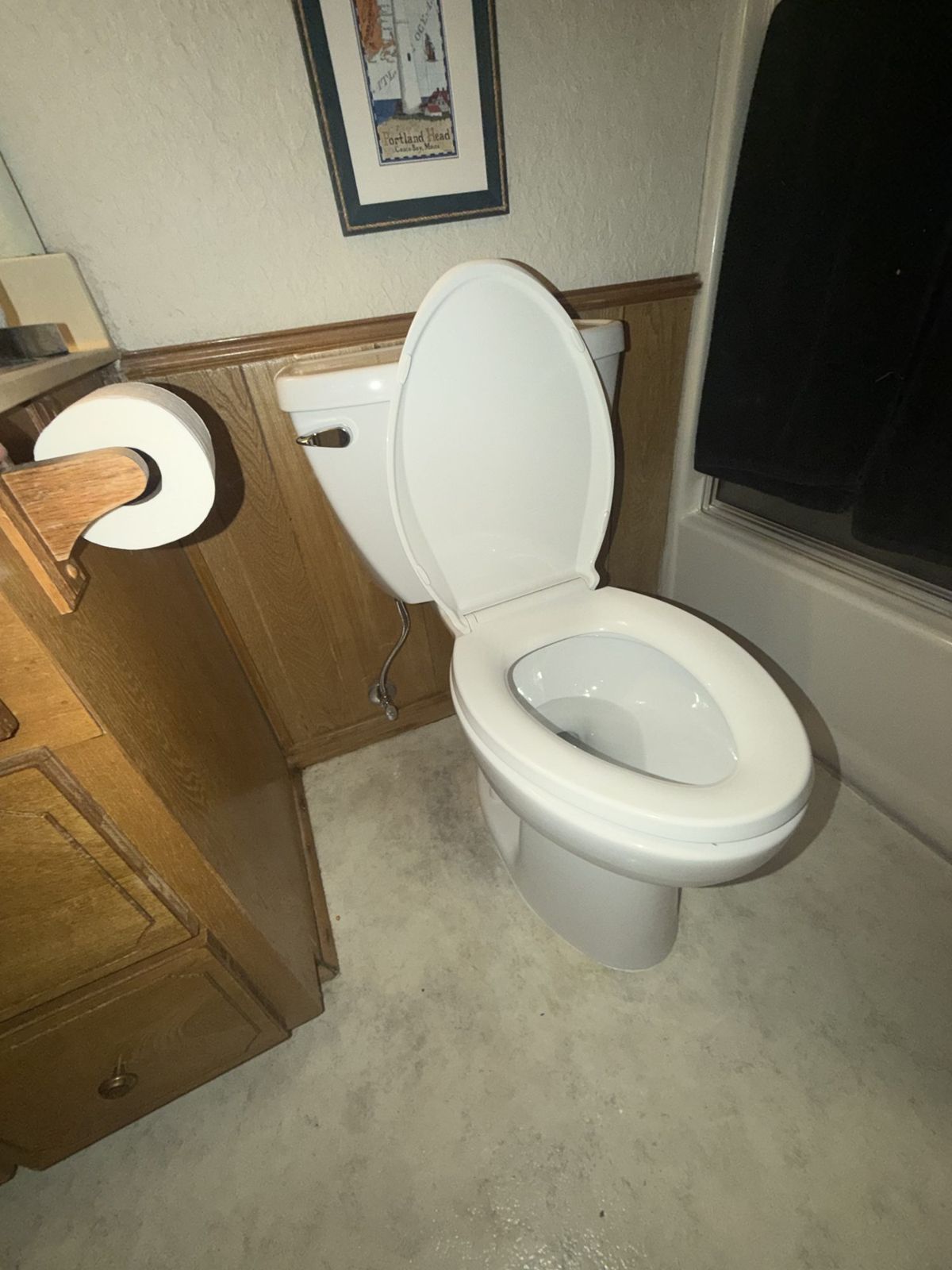
Most toilet repair calls fall into one of these. A few are quick part swaps. Others point to something under the floor or down the line that needs a closer look.
Running or refilling on its own
A worn flapper, a fill valve that won't shut off, or a float set too high. It wastes a lot of water and you'll see it on the water bill.
Weak flush
A weak flush usually comes from a low water level in the tank, a flapper that closes too early, or rim jets packed with mineral scale. A partial clog in the trap or the drain line does it too.
Water around the base
Usually a failed wax ring, a broken closet flange, or loose bolts. Sometimes it's not the base at all but a sweating tank or a dripping supply line. We figure out which before pulling anything.
Leaking between the tank and bowl
Drips from the bolts under the tank mean the tank to bowl gasket or the bolt washers have worn out. Left alone, it soaks the floor behind the toilet where you don't look.
Leaking supply line or shutoff
The braided supply line and the angle stop on the wall wear out too. An old shutoff that won't close is a problem the day you need it, so we replace those when they're bad.
Constant clogs
A toilet that clogs over and over has a reason, whether it's the toilet itself, something stuck in the trap, or a problem farther down the drain.
Running toilet: what's going on inside the tank
A running toilet is the most common toilet repair there is. When you flush, the flapper lifts and lets the tank empty into the bowl. Then it drops back down, and the fill valve refills the tank until the float tells it to stop. When the toilet keeps running, one of those parts isn't doing its job.
- The flapper. Rubber flappers get warped and stiff with age and chlorine. Water leaks past them into the bowl, the tank level drops, and the fill valve kicks on for a few seconds. If your toilet refills by itself in the middle of the night, that's usually the flapper.
- The fill valve. If water is running into the overflow tube, the fill valve isn't shutting off, or the float is set too high.
- The chain. Too short and the flapper can't seal. Too long and it gets caught under the flapper.
Here's a simple test: put a few drops of food coloring in the tank and don't flush for 15 to 20 minutes. If color shows up in the bowl, the flapper is leaking. A slow silent leak like that can run up your water bill for months without you hearing a thing.
If you keep replacing fill valves and flappers, look at the water itself. Hard water scale makes parts stick and wear out early, and a water softener can help. High water pressure is the other common cause. Most plumbing codes call for a pressure reducing valve when house pressure is over 80 PSI. One of our customers in a newer construction home had 110 PSI, and pressure that high is hard on every valve in the house. We check pressure when parts keep failing.
Toilet overflowing? Do this first
- Find the shutoff valve (the angle stop) on the wall behind the toilet and turn it clockwise until it stops. That cuts off water to the tank.
- If the valve won't turn, take the tank lid off and push the flapper down, or lift the float up, to stop the water.
- Don't flush again. Every flush puts more water on the floor.
- If water is coming up in a tub, shower or floor drain too, stop running water in the house. That points to a main line clog.
- Call or text (903) 458-4026. We have emergency plumbers on call 24/7.
Clogged toilet: when plunging isn't enough
A good plunger fixes a lot of clogged toilets. Use a flange plunger (the kind with the extra rubber sleeve on the bottom), make a good seal, and push and pull steadily rather than slamming it. If a dozen good plunges haven't moved it, stop there. Forcing it with chemicals or a wire hanger can scratch the porcelain or make the clog worse, and chemical drain cleaners sitting in a toilet bowl are a hazard for whoever comes next.
Things we pull out of toilets all the time:
- So-called flushable wipes. They don't break down like toilet paper, and they snag in pipes and pile up.
- Paper towels, feminine products and cotton swabs.
- Kids' toys, toothbrushes and phones that fell in.
- Too much paper at once in a low flow toilet.
When it won't clear, we use a toilet auger to reach through the trap without damaging the bowl. If something solid is stuck, sometimes the toilet has to come off the floor so we can push it out from the other side.
If your toilet keeps clogging, the toilet may not be the problem. When the tub gurgles as the toilet flushes, or more than one drain is slow, there's likely a blockage in the main sewer line. That's a job for our drain cleaning service, and a sewer camera inspection shows exactly what's in the line, whether it's roots, a belly or a broken pipe. We cover the warning signs in more detail in when to call a plumber for a clogged toilet.
Leaks at the base and a toilet that rocks
A toilet sits on a wax ring that seals it to the closet flange, the fitting on the floor that connects to the drain pipe. When that seal fails, water seeps out at the base every time you flush. Sometimes you see a puddle. Sometimes you only notice a sewer smell, a stain on the ceiling below, or flooring that feels soft.
A toilet rocking side to side is a warning sign. Every wobble works the wax ring loose, so a rocking toilet usually ends up leaking. Tightening the bolts is only a fix if the flange and floor underneath are solid. Overtighten them and you can crack the porcelain.
Here's what we check when we pull a leaking toilet:
- The closet flange. Cracked, rusted or broken flanges are common, and a new wax ring won't seal on a bad flange. We repair or replace it.
- The flange height. After new tile or flooring goes in, the flange can end up too low for a standard wax ring to seal.
- The subfloor. In pier and beam homes, a slow leak at the toilet can rot the subfloor around the flange. We'll show you what we find. On a slab foundation, the flange sits in concrete, so the concern is more about the drain and water getting under the flooring.
If you have water damage and the toilet checks out fine, the water may be coming from somewhere else, like a supply line inside the wall or a shower pan. Our leak detection service tracks it down before anyone starts tearing up the floor.
Repair or replace your toilet?
Most toilets can be repaired. Tank parts are cheap and fit almost every model. We'll tell you straight when a repair makes sense and when you'd be throwing good money after bad. Replacement is usually the better call when:
- The tank or bowl has cracked porcelain. Cracks only get worse, and a cracked tank or bowl can let go without warning.
- You're calling about the same toilet every few months.
- It's an older toilet that uses far more gallons per flush than newer models. Current toilets sold in the US are generally 1.6 gallons per flush or less.
- You want a comfort height toilet (closer to chair height) or an elongated bowl, which a lot of people find easier on knees and backs.
- Replacement parts for an odd or discontinued model are hard to find.
How our toilet installation works
A toilet installation looks simple, and most of the problems we see on someone else's install come from the steps people rush. Here's how we do it.
Measure the rough-in
The rough-in is the distance from the wall to the center of the drain. Most homes are 12 inches, but 10 and 14 inch rough-ins are out there. It decides which toilets will fit, so we check it before you buy one.
Shut off the water and pull the old toilet
We shut off the angle stop, drain the tank and bowl, disconnect the supply line and lift the old toilet off the flange. If the shutoff won't close tight, we replace it.
Check the flange and floor
With the old toilet off, we look at the closet flange and the floor around it. Broken flanges and soft spots get dealt with now, since you can't get at them once the new toilet is down.
Set the new toilet
New closet bolts, a new wax ring (or a wax-free seal when it fits the situation better), and the toilet set level and solid with no rocking. We snug the bolts down evenly so we don't crack the base.
Connect and test
A new supply line goes on, we turn the water back on, adjust the fill level, and flush it several times while watching the base, the tank bolts and the supply connection for any drips.
What affects the price of toilet repair or installation
We don't post flat prices because two toilets with the same symptom can need very different work. We look first, then give you an upfront quote, with options when there's more than one way to fix it. Estimates are free.
- The part that failed. A flapper or fill valve is a quick fix. A leak at the base means pulling the toilet.
- What's under the toilet. Flange repair or subfloor damage adds time and materials.
- The shutoff and supply line. Old angle stops that won't close get replaced.
- Clogs. A simple auger job costs less than a clog that needs the toilet pulled or the main line cleared.
- The new toilet itself, if you're replacing it, and which model you pick.
Call or text (903) 458-4026, or send us your address and what the toilet is doing.
What customers say
★★★★★
"I reached out to the company after a DIY disaster with my toilet, and I'm so grateful for how quickly and kindly they responded."
Trivia G. · Google review
★★★★★
"Blake and JB came out and fixed toilet clog on a Sunday and were done in 20 minutes"
Ryan G. · Google review
★★★★★
"It was on a Saturday afternoon... She had Blake come out within the hour (or less) of my calling."
Gene H. · Google review
Toilet Repair and Installation around Hunt and Rains counties
We handle toilet repair and installation for homes and businesses in Lone Oak and the towns around it, about a 60-mile radius from our shop. Pick your town below to see how we work there, or see all of our service areas.
Common questions
Toilet giving you trouble?
Call or text (903) 458-4026, or text us a photo of the problem. We'll tell you what we see and what it'll take to fix it.